
How many restrooms does a county fair actually need?
Start with your expected peak headcount, not your average. A fair pulling 3,000 people through the gate on a Saturday afternoon needs more capacity than the same event on a slow Tuesday morning, even though total attendance for the week might look similar on paper. Standard porta potty rental units handle most of that volume, and OSHA 1926.51(c) sets the baseline ratio for worker sanitation on a job site: one toilet for 20 or fewer people, then a step up in facilities as headcount climbs past 20 and again past 200. Fairgrounds aren't construction sites, but the same math applies to crowd planning, and organizers who use it rarely run short. Whittier Porta Pros builds a placement plan using the porta potty placement guide and adjusts for concessions, midway games, and grandstand seating, since those areas cluster people differently than open lawn space. For a fair with beer gardens or wine tastings, event restroom rental counts should run higher than a family daytime event with the same total attendance. If you're not sure where to start, the how many porta potties do I need guide walks through the math step by step, and a request a quote call gets you a real number fast.
What kind of restrooms fit a county fair?
Most fairs mix three types: standard units for general crowd flow, at least one ADA-compliant stall per cluster, and a small restroom trailer or two near VIP areas or staff tents. ADA Standards section 213.2 requires that at least 5 percent of clustered single-user units be accessible, with a minimum of one, so a bank of eight units needs at least one ADA stall meeting that spec. Our ADA accessible porta potty units meet ADA Standards section 404.2.3 for a 32 inch clear door opening and section 304.3.1 for a 60 inch turning circle inside the stall, so a wheelchair user isn't fighting the door or the floor space once they're in. For fairs with a hospitality tent or sponsor area, a deluxe flushable porta potty or a full restroom trailer rental reads a lot better than a bank of standard units. A 4 stall restroom trailer works well near a beer garden or main stage, and an 8 stall restroom trailer covers larger grandstand crowds without a long walk. Handwashing matters too: 29 CFR 1910.141(d)(2) requires soap and towels or a hand-drying device at washing stations, and hand sanitizer alone doesn't satisfy that standard. A handwashing station rental placed near food booths covers that requirement and keeps lines at food vendors moving.
Where should restrooms go on a fairground layout?
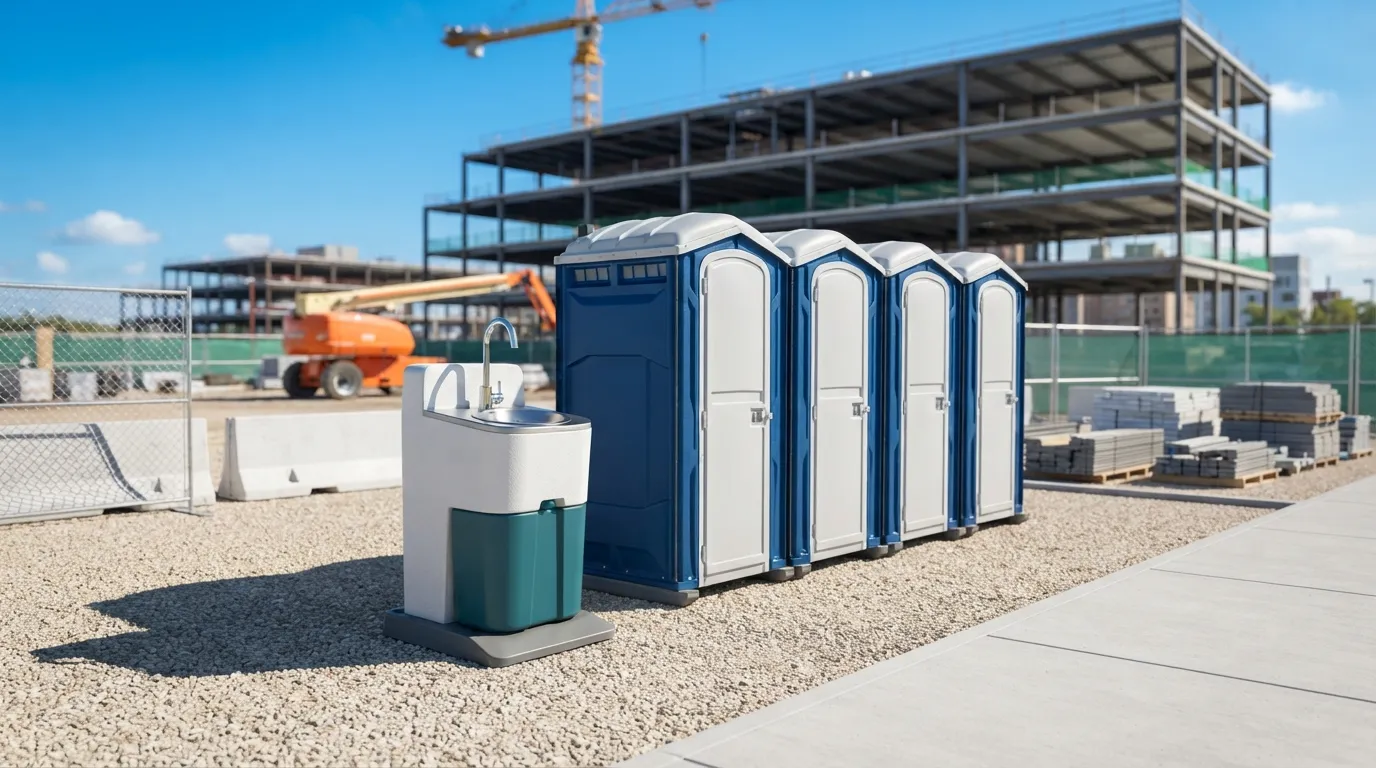
Restrooms belong near high-traffic nodes, not tucked behind the last row of vendor booths. Place clusters near the midway entrance, near grandstand seating, and near any beer garden, since those three spots generate the steadiest lines throughout a fair day. ADA Standards section 403.5.1 requires a 36 inch clear accessible route to each unit, so pathways need to stay wide and level, especially across grass or gravel lots where a standard unit's 44 by 48 inch footprint can sink if the ground softens. OSHA 1926.56(a) sets minimum lighting levels for work areas after dark, and fairs running into the evening should treat restroom paths the same way; a light tower rental near a restroom cluster keeps that walkway visible once the sun drops. Whittier fairgrounds often need generator power nearby too, so a temporary power pole can run alongside restroom banks and food vendor rows. If your fair site sits close to city streets, check placement against the porta potty permit requirements page, since curb and right-of-way placement in Whittier needs confirming with the city before delivery. Waste from food booths also needs a plan: a roll-off dumpster rental or two near vendor row keeps trash from piling up between pickups, and temporary fence rental sections can keep crowds from crossing behind restroom banks into staging areas.
| unit | duration | typical price |
|---|---|---|
| standard | event | $400 |
| ada | day | $230 |
| trailer | event | $3500 |
| deluxe | week | $250 |
Prices above reflect measured event-rate bands; a porta potty rental cost page breaks down day, week, and month pricing in more detail if your fair runs longer than a weekend.
How far in advance should I book restrooms for a fair?
Book as soon as your date and headcount estimate are set, ideally a month or more out for a multi-day fair. Fairgrounds nearby in Santa Fe Springs, 4.8 miles southwest of Whittier, and Pico Rivera, 5.5 miles west, often book the same delivery trucks during peak fair season, so early scheduling avoids conflicts.
Do fairs need ADA-compliant restrooms even for a one-day event?
Yes. ADA Standards section 213.2 applies regardless of event length, requiring at least one accessible unit per cluster of single-user toilets, with a 5 percent minimum ratio once cluster size grows past that.
Can Whittier Porta Pros deliver to gravel or grass fairground lots?
Yes, in most cases. ADA Standards section 302.1 requires stable, firm, slip-resistant surfacing along accessible routes, so we assess ground conditions ahead of delivery and use leveling boards or spot placement where the lot needs it.
What happens if the fair runs longer than expected?
Call us and we'll extend service same day where possible. Our emergency porta potty rental line covers last-minute extensions, added units, or extra servicing if crowd size outpaces your original count.
Should I add handwashing stations separate from the restrooms?
Yes, especially near food vendors. A portable sink rental or dedicated handwashing station near concession rows keeps food safety separate from restroom lines and meets 29 CFR 1910.141(d)(2) for soap and drying access.
Next step
Get a delivery date
Tell us the address, the dates and the headcount. We size the order and confirm the route.